

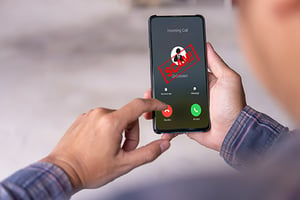
October is Cybersecurity Awareness Month and the perfect time to learn more about how to protect yourself from fraud and scams. While fraud and scams are nothing new, the methods criminals use continue to change. Today’s scammers can make a phone call appear to come from a legitimate business, create convincing emails and text messages, and use information found online or exposed through previous data breaches to make their stories seem believable.
At ONE AMERICAN BANK, we want our customers and communities to know what to watch for and, more importantly, what to do when something doesn’t feel right.
The Federal Trade Commission reports that impersonation scams remain one of the most reported forms of fraud. In 2025, consumers reported more than one million imposter scams and nearly $3.5 billion in losses.
Here are several types of scams that bank customers should recognize.
1. Someone Calls Pretending to Be Your Bank
A call appears on your phone, and the caller ID shows a number you recognize. The caller says there is suspicious activity on your account and needs to verify some information.
There’s just one problem: the caller may not actually be your bank.
Caller ID information can be spoofed. In fact, ONE AMERICAN BANK has previously received reports from customers about calls that appeared to originate from one of our legitimate telephone numbers.
A criminal may use that credibility to ask for information such as your:
- Online banking password
- PIN
- One-time security or verification code
- Debit card or account information
What should you do?
If you are uncertain about a call, hang up. Then contact the bank using a telephone number you already know is legitimate rather than a number provided by the caller.
ONE AMERICAN BANK will never contact you to ask for your digital banking password. Our existing customer security guidance also recommends contacting us using trusted contact information because scammers may provide fraudulent contact details.
2. Phishing Emails and Fake Text Messages
You receive an email or text saying something like:
“Suspicious activity detected. Click here immediately to secure your account.”
Messages like these are designed to create urgency. The link may lead to a website that looks like a legitimate banking website but is actually controlled by criminals attempting to capture your credentials.
Phishing is one of the methods criminals use to steal passwords, and compromised credentials can lead to unauthorized account access, fraudulent payments or transfers, and misuse of personal information.
Slow down before you click.
Instead of following a link in an unexpected message, access online banking the way you normally do or contact the bank directly.
3. “Move Your Money to Keep It Safe”
This is an especially dangerous form of impersonation scam.
A caller may claim that your bank account has been compromised and tell you that you need to move money immediately to another account for safekeeping.
That sense of urgency is a warning sign.
Government agencies have specifically warned about scammers convincing victims to move money under the guise of protecting it. The FTC advises that its employees, for example, will never tell consumers to move their money in order to keep it safe.
Never move money simply because an unexpected caller tells you that you must act immediately.
Stop and independently verify what you are being told.
4. Check Fraud and Check Washing
Paper checks remain a target for criminals.
Fraudsters may steal checks from the mail and alter the payee or dollar amount, a practice commonly called "check washing." Stolen check information may also be used in additional fraudulent transactions.
The Association for Financial Professionals' 2026 fraud outlook reports that check fraud remains a significant risk despite the move toward electronic payments, including incidents involving stolen, altered, and duplicated checks.
Customers who write checks should periodically review their accounts and promptly investigate transactions they don't recognize.
5. Business Email and Vendor Impersonation
Businesses face another variation of the impersonation scam.
A criminal may gain access to, spoof, or imitate a vendor's email account and send new payment instructions:
“We've changed banks. Please use this new account for our next payment.”
Everything about the request may look routine.
The 2026 AFP Payments Fraud Outlook describes real-world cases in which fraudulent vendor communications provided changed banking instructions that appeared legitimate.
For businesses, a good rule is simple: a change to payment instructions deserves independent verification.
Contact the vendor using contact information you already have rather than relying solely on the email requesting the change.
6. Scams Targeting Older Adults
Older adults can be particularly vulnerable to financial exploitation and impersonation schemes.
Some warning signs include unexpectedly large withdrawals, unusual wire or ACH requests, purchases of large amounts of gift cards, sending money to unfamiliar people, or suddenly moving money because someone claims there is an emergency. These are among the warning signs identified in One American Bank's financial exploitation procedures.
Family members should also be attentive to sudden, unexplained changes in financial behavior, particularly when a new person appears to be directing someone's financial decisions.
Technology Has Made Impersonation Easier
Scammers don't necessarily need to sound suspicious anymore.
Artificial intelligence and other readily available technologies are making it easier to produce convincing messages and impersonate individuals. In an internal fraud-awareness communication, One American Bank specifically warned employees that AI is increasing the challenge posed by social engineering and emphasized verifying financial transactions through known contact information.
That makes an old piece of advice more important than ever:
Don't rely solely on how convincing a person sounds or how legitimate a message looks. Verify independently.
Stop. Verify. Then Act.
Many scams depend on getting you to act before you have time to think.
If someone contacts you unexpectedly about your money:
Stop.
Don't let urgency or threats pressure you into acting immediately.
Verify.
Contact ONE AMERICAN BANK or the business supposedly contacting you using a phone number, website, or other contact information you know is legitimate.
Protect your credentials.
Never provide your password, PIN, or security code because an unexpected caller, email, or text asks for it.
Review your accounts.
Regularly look for transactions or changes you don't recognize.
Use multi-factor authentication.
ONE AMERICAN BANK encourages customers to use MFA as an additional layer of protection for digital banking accounts.
We're Here to Help
Community banking is built on relationships. If something involving your account doesn't seem right, contact us before sending money or providing information.
It's much better to pause and verify a legitimate transaction than to discover afterward that the person contacting you wasn't who they claimed to be.
Working together, we can make it much harder for scammers to succeed.